

Monetro vs FTMO vs FundedNext is the comparison almost every new funded trader runs into — three firms, three slick websites, and every one of them swearing it’s the fairest, fastest and most trusted prop firm in the business. They can’t all be right. And most comparison pages you’ll find are written by whoever earns the biggest affiliate commission.
So here’s a Monetro vs FTMO vs FundedNext comparison written differently. We run Monetro, so we have a side — and we’ll tell you plainly where we win and where FTMO and FundedNext have a real edge over us. By the end you’ll know which of the three fits you, not which one shouts loudest.
Quick verdict
- Cheapest first try: Monetro ($29) and FundedNext ($32.99) are neck-and-neck; FTMO costs more (about €155 standard).
- Friendliest rules: Monetro — static drawdown on the multi-step models and no consistency rule on any plan.
- Best track record: FTMO, on years in market.
- Fastest payouts: Monetro — roughly 8-hour average processing once eligible.
Monetro vs FTMO vs FundedNext at a glance
Here is the short, honest version in one table. Every Monetro figure below is the live, published number from our own challenge pages.
| Feature | Monetro | FTMO | FundedNext |
|---|---|---|---|
| Cheapest challenge fee | $29 (Endurance $5K) | ~€155 (€10K, standard) | $32.99 (Stellar Lite $5K) |
| Account sizes | $5K–$200K | €10K–€200K | $5K–$200K |
| Profit split | 80% flat | 80% (up to 90% scaled) | 80%–95% |
| Daily loss limit | 4%–5% | 5% | Varies by model |
| Max drawdown | 6% static (Velocity) / 10% static | 10% static | Balance-based, varies |
| Consistency rule | None | None on challenge | Some models |
| Payout speed | ~8h average | Days | Days |
| Base / platform | UAE · cTrader, raw ECN | Europe | Global |
The 30-second version of who these three firms are
All three are prop firms, short for proprietary trading firms. The model is the same across the industry: you pay a one-time fee for an evaluation (the “challenge”), you hit a profit target without breaking the risk rules, and then you get a funded account and keep most of the profits. Where they differ is in the details that quietly decide whether you pass, get paid, and come back.
FTMO is the incumbent. It’s been operating for roughly a decade, it’s based in Europe, its accounts are priced in euros, and it’s forex-first. When people say “prop firm” without naming one, they often picture FTMO. Its biggest asset is simply that it has been around longer than almost anyone and has paid a lot of traders.
FundedNext is the aggressive challenger. It offers a wide spread of account types — Stellar Lite, 1-Step, 2-Step, Rapid, and more — and competes hard on profit splits and promotions. Its strength is choice; its weakness is that the choice can be overwhelming when you’re new.
Monetro is the newcomer built around one idea: be the honest prop firm. We’re UAE-registered, we trade on cTrader with raw ECN pricing, and we publish every rule and fee in plain English. We’re younger than the other two, and we’ll come back to what that means for you.
Price: what you actually pay to start
For a first account, the entry fee matters more than anything, because you’re buying a test, not a guarantee. You want the cheapest honest way to find out whether you can pass.
At Monetro, the lowest entry point is $29 for a $5,000 Endurance challenge. Step up to a $50,000 account and you’re looking at $229 on Endurance, $299 on Evolution, or $329 on Velocity, depending on how fast a path you want. Those are the live, published prices — no “limited-time” timer that resets every time you reload the page.
FundedNext’s cheapest route is its Stellar Lite $5,000 account at around $32.99 — close to Monetro’s entry, and a genuinely competitive number. FTMO starts higher: a €10,000 account runs roughly €89 on promotion and about €155 at standard pricing, which at current exchange rates is meaningfully more than either of the others for a comparable small account. You’re partly paying for FTMO’s track record there, which for some traders is worth it.
The honest takeaway on price: Monetro and FundedNext are in the same low-cost bracket for a first try, and FTMO charges a premium. If your only goal is to test yourself cheaply, the gap between a $29 and a €155 first attempt is real money.
If you want to see exactly what each Monetro model costs at every account size, the full table is on our challenges page — no signup, no email required.
Drawdown rules that decide whether you keep your account
This is where beginners get caught, so read this section twice. The fee gets you in the door. The rules decide whether you survive. Two of them matter most: drawdown and the consistency rule.
Drawdown is the maximum you’re allowed to lose before the account is closed. There are two flavours, and the difference is bigger than it sounds.
A static drawdown is measured from your starting balance and never moves. If your limit is 10% on a $50,000 account, your floor sits at $45,000 — full stop — no matter how much profit you make. A trailing drawdown follows your account up as you win, which sounds friendly but is actually harder: a good run raises the floor beneath you, and a normal pullback can breach a limit you didn’t realise had moved.
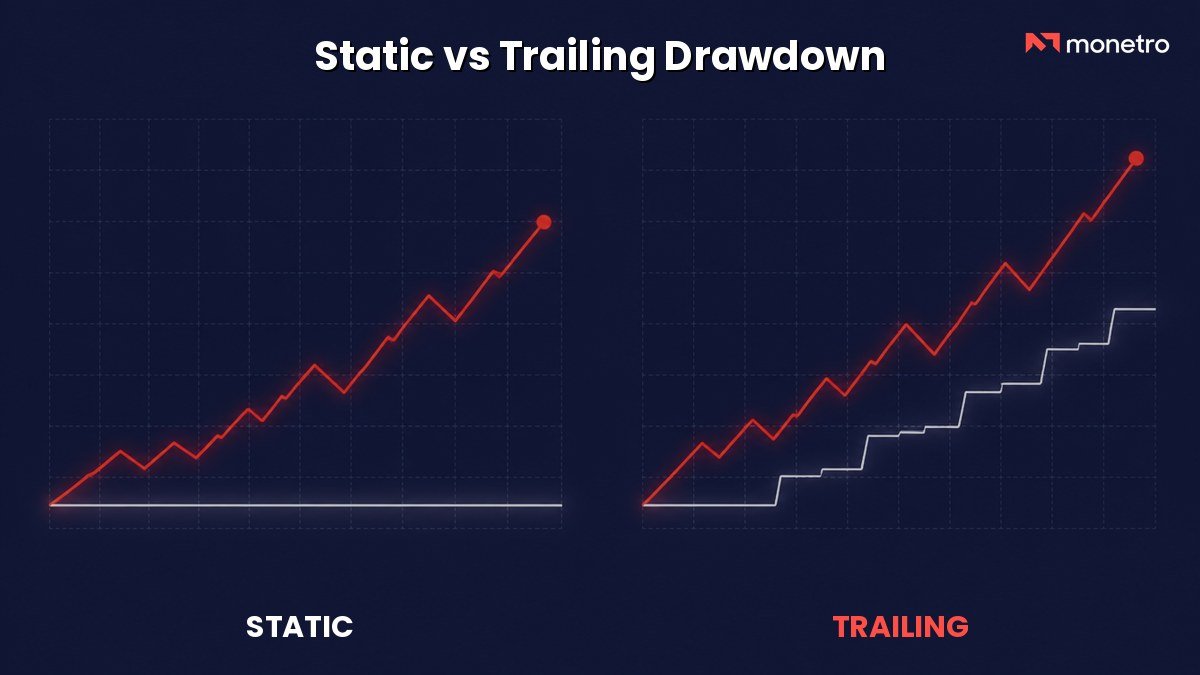
Here’s how the three compare. Monetro uses a static 10% maximum drawdown on its Evolution (2-step) and Endurance (3-step) models, with a 5% daily loss limit. Our fastest model, Velocity (1-step), uses a tighter 6% static maximum and a 4% daily limit — that’s the trade-off for the quickest path to funding. FTMO uses a static 10% maximum drawdown with a 5% daily limit, very similar to our multi-step models. FundedNext’s drawdown is balance-based and varies by which of its many models you choose, so you have to read the specific product carefully before you buy.
The consistency rule is the one that surprises people after they’ve already passed. Some firms require your profits to be spread evenly across days — make too much on one good trade and your payout can be held or reduced. Monetro has no consistency rules on any model. FTMO doesn’t apply one on the challenge itself, though it reviews unusually concentrated funded-account results. FundedNext applies none on its main CFD 2-Step and Lite accounts but does enforce them on certain futures models. None of this is hidden by any of the three — but it’s the kind of clause a new trader skips right past, and then learns about at the worst possible moment.
A last detail worth knowing: across every Monetro challenge, your exposure on any single trade is capped at 2% of the account. That’s a guardrail, not a gotcha — it exists to stop one reckless position from ending your evaluation.
Profit split and payouts: getting paid
The profit split is the share of your trading profits you keep. All three firms cluster around the same headline number. Monetro pays a flat 80% on every model — no tiers to climb, no fine print. FTMO starts at 80% and can reach 90% through its scaling plan over time. FundedNext ranges from 80% on its standard accounts up to 90–95% on its premium tiers. So if a high split is your single priority, FundedNext’s top products and FTMO’s scaled accounts edge ahead of our flat 80%. We chose one clear number over a ladder you have to climb; that’s a preference, and yours might differ.
Payout speed is where Monetro pushes hardest. Once you’re eligible, our approved payouts process in an average of 8 hours. Your first payout becomes eligible 14 calendar days after your first trade, with at least 5 trading days completed; after that, you can request every 14 days. FTMO and FundedNext both pay reliably — that’s not in question — but their standard cycles are measured in days, not hours. For a trader who wants to see the model actually work quickly, fast payouts are reassurance you can feel.
Is it a scam? How to vet Monetro, FTMO or FundedNext
Underneath the price and rules comparison there’s usually one quiet worry: is this whole thing a scam? It’s a fair question. The category earned the suspicion. When MyForexFunds was shut down in 2023, a lot of traders with passing accounts and pending payouts lost everything overnight, and “prop firm” became a word people said carefully. So before you hand any firm your card details, vet it the same way for all three.
Check three things. First, is the company a real, registered legal entity? FTMO is an established European company; FundedNext is a registered firm operating at scale; Monetro is a registered technology company in the UAE. A real address and registration are the floor, not the ceiling, but a firm that hides them fails the test immediately.
Second, are the rules published in full, before you pay? You should be able to read the drawdown limits, the consistency policy, the payout schedule and the list of restricted strategies without creating an account. If you have to buy first to find out what you bought, that’s the warning sign. All three of these firms publish their rules; plenty of smaller ones don’t.
Third, do the payouts actually happen, on the terms stated? Look for real trader payout evidence and a withdrawal process described in concrete numbers, not vague promises. This is the single hardest thing for a brand-new firm like Monetro to prove, simply because we haven’t had as many years to build a public payout history as FTMO has. We’re honest about that. The way we compete on it is by making the process fast and the terms plain. You can read every rule on our FAQ page before you spend a cent.
So which one should a beginner actually pick?
Here’s the honest sort in the Monetro vs FTMO vs FundedNext decision, with no firm pretending to be all things to all people.
Pick FTMO if track record is what lets you sleep at night. It’s the oldest and most proven of the three, and if paying a premium for a decade of history feels worth it to you, that’s a completely rational choice. We’d rather tell you that than pretend our few months in market match ten years of theirs.
Pick FundedNext if you want maximum choice and you’re willing to do the homework. Its range of models lets you fine-tune your account to a specific style, and its top tiers offer the highest profit splits in this comparison. The cost is complexity — you have to actually read each product’s rules, because they differ.
Pick Monetro if you want the simplest honest version: a low entry fee starting at $29, static drawdown on the multi-step models, no consistency rules anywhere, a flat 80% split, and payouts that land in hours. We’re the new firm, so we don’t have FTMO’s years behind us — but everything we do have is published, in plain English, with no timer pressuring you to buy.
If you’re brand new and just want to test yourself without overthinking it, start small and cheap on any of the three. The point of a first challenge isn’t to get rich — it’s to find out, for a price you won’t miss, whether funded trading is for you.
Frequently asked questions about Monetro vs FTMO vs FundedNext
Is Monetro better than FTMO?
It depends on what you value. FTMO wins on track record and years of public payout history. Monetro wins on price (from $29), a flat 80% split, no consistency rule, and roughly 8-hour payout processing. For a low-cost, low-friction first challenge, Monetro is the easier on-ramp; for maximum proven history, FTMO leads.
Which is cheapest — Monetro, FTMO or FundedNext?
Monetro is the cheapest entry at $29 for a $5K Endurance challenge, with FundedNext close behind at $32.99 for its $5K Stellar Lite. FTMO is the most expensive of the three, at roughly €155 for a standard €10K account.
Do Monetro, FTMO and FundedNext have a consistency rule?
Monetro has no consistency rule on any model. FTMO has none on the challenge itself but reviews unusually concentrated results on funded accounts. FundedNext applies none on its main CFD 2-Step and Lite accounts, but does enforce one on certain futures models.
Which prop firm pays out fastest?
Monetro processes approved payouts in an average of about 8 hours once you’re eligible. FTMO and FundedNext both pay reliably, but their standard cycles are measured in days rather than hours.
Is Monetro or FundedNext better for beginners?
Both are beginner-friendly on price. Monetro keeps things simpler with one flat 80% split and no consistency rule, while FundedNext offers more account types to choose from. Beginners who want fewer decisions tend to prefer Monetro; those who want to fine-tune their setup may prefer FundedNext.
Related reading
- Prop firm payout rules: what pay-day mechanics reveal — how the first-payout window, cadence and processing time differ across all five firms.
- Prop firm reset fees: how firms make money when you fail — what a failed challenge actually costs at each firm, and who refunds your fee.
- The 80/20 rule of prop firm risk management — the four decisions behind most blown funded accounts.
- Cheapest prop firm in 2026 — a full entry-fee table, and when the cheapest option is the wrong buy.
The bottom line
There’s no universal “best” prop firm, and any Monetro vs FTMO vs FundedNext comparison that names one winner without asking about you is selling something. FTMO wins on track record. FundedNext wins on flexibility and top-end splits. Monetro is built to win on honesty: clear rules, low fees, no consistency traps, and 8-hour payouts — with the open acknowledgement that we’re still earning the years the others already have.
If that trade — proven history versus transparent simplicity — sounds like the one you’d take, you can see every Monetro rule and price for yourself before you spend a cent. And if you decide to start, our Founding Traders offer takes 40% off your first challenge with code NEW40 at upcoming.monetro.com. Read everything first. An honest firm is one that wants you to.